Website Personalization: The Complete Guide for Marketing, E-Commerce, and Sales
Website personalization means showing every visitor exactly the content that fits their situation - automatically and in real time. This guide explains the most important methods, the role of AI, and what matters when choosing a solution.

What is website personalization? A definition
Website personalization refers to the automatic adaptation of a website's content, copy, and messaging to the respective visitor - in real time, without manual intervention and without requiring the user to take any action. Instead of a uniform page that looks identical to all visitors, each user receives exactly the content that matches their situation, their industry, or their context.
Website personalization is therefore more than a technical feature: it is a strategic decision in favor of greater relevance - and relevance is the single most important factor for a high conversion rate today.
What is the difference between website personalization and A/B testing?
In A/B testing, two or more variants of a page are tested against each other to find out which variant performs better. The result is a single, optimized version for all visitors. Website personalization goes further: here, different variants are not tested but delivered permanently and simultaneously to different visitor groups. Each target group permanently sees the version relevant to them - not after a test, but from the very beginning.
What is the difference between website personalization and targeting?
Targeting describes the deliberate delivery of advertisements to specific target groups - outside your own website, for example on social networks or search engines. Website personalization picks up where targeting leaves off: on your own website, after the visitor has already arrived.
Why website personalization is decisive today
The expectations of website visitors have changed fundamentally in recent years. Users are accustomed to receiving personalized experiences - from streaming services, online shops, and social networks. A generic company website that treats every visitor the same, by contrast, increasingly feels like a mass brochure rather than a competent conversation partner.
more revenue through personalization
Source: McKinsey ((opens in a new tab))
The numbers prove it: according to McKinsey, companies that consistently use personalization generate up to 40 percent more revenue than the industry average. And yet, especially in the German mid-market, very few companies still use website personalization systematically - even though the technical options are more accessible today than ever before.
Who is website personalization relevant for?
Website personalization is not a topic exclusively for large e-commerce platforms. It is relevant for any company that:
- wants to address several different target groups through a single website
- runs marketing campaigns and wants to convert the traffic from those campaigns in a targeted way. Learn how personalized landing pages with UTM parameters work in the guide.
- wants to win B2B customers from various industries – learn more about industry-specific personalization for B2B
- wants to improve its conversion rate without rebuilding the website from scratch
- wants to use content resources efficiently and not maintain separate landing pages for every target group
How does website personalization work? The two most important methods of AutoPersona.app
Method 1: Personalization via UTM parameters
UTM parameters (Urchin Tracking Module) are additional pieces of information transmitted in the URL of a website address - typically when clicking on an ad, a newsletter link, or a social media post. They provide precise information about which channel, which campaign, and which medium brought a visitor to the page and can be analyzed in Google Analytics.
A concrete example:
www.yourwebsite.com/?utm_campaign=manufacturing&utm_source=linkedin&utm_medium=adA website personalization solution like AutoPersona.app automatically evaluates these parameters and delivers the matching content. A visitor arriving via a LinkedIn campaign for manufacturing sees a different headline and different intro copy than a visitor from a newsletter for retail - on the same URL, without separate landing pages.
Advantages of UTM-based personalization:
- Direct continuation of the campaign message on the website
- Higher relevance for campaign-driven traffic
- Measurable impact per campaign and channel
- No need to build and maintain separate landing pages. Learn how personalized landing pages with UTM parameters work in the in-depth guide.
Method 2: Industry detection via the IP address
Not every website visitor arrives via a campaign. Organic traffic, direct visits, or referrals provide no UTM parameters. For these visitors, IP-based industry detection offers a powerful alternative.
Via a connected API, the industry of the visitor's company is determined from their IP address. This happens fully automatically, in real time, and without the user having to fill out a form or log in. A visitor from a company in the automotive sector automatically sees different content than a visitor from healthcare - even though both open the same URL.
Advantages of IP-based industry detection:
- Personalization even without campaign traffic
- No cookies, no active user interaction required
- GDPR-compliant use possible
- Especially effective for B2B websites with a heterogeneous target audience. Learn how B2B website personalization works in detail in our in-depth guide.
Website personalization with AI: scalable and resource-efficient
The most common objection to website personalization is: “We don't have the capacity to create dedicated copy for every target group.” This objection was justified - as long as copywriting was done exclusively by hand.
Modern personalization solutions like AutoPersona rely on AI-powered copywriting: content managers and editors define the target segments and provide content guardrails. Based on this, the AI generates suitable copy suggestions for each segment - editors review, refine, and approve them. The actual writing is handled by the AI.
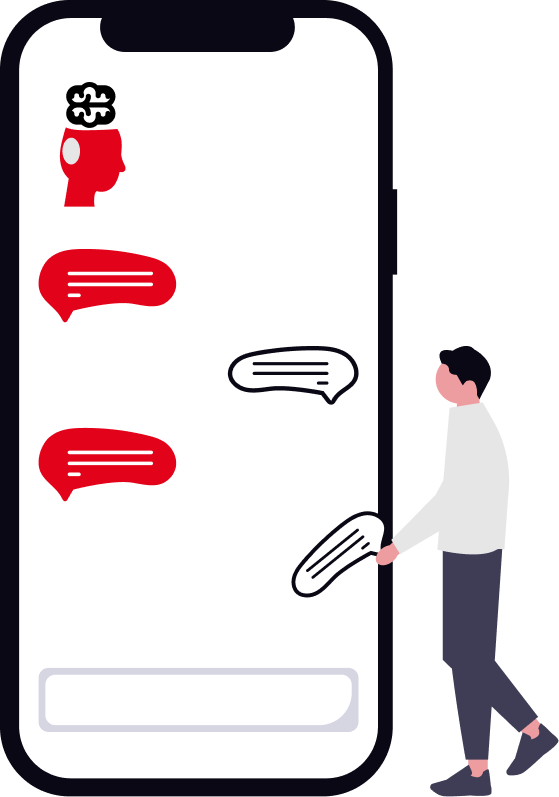
AI writes the copy. Your team decides.
Set the guardrails
Editors define target segments and content guidelines.
AI generates the variants
Matching copy suggestions are created for each segment.
Review and approve
Quality control stays with the editorial team.
This fundamentally changes the editor's role: instead of time-consuming manual copywriting for each individual target group, strategic steering and qualitative control move to the center. Website personalization thus becomes realistic and scalable even for teams with limited resources - regardless of how many target groups are to be addressed.
Website personalization without CMS dependency: here's how
A common obstacle when introducing personalization solutions is the technical dependency on a specific content management system. Many providers require deep integration into the respective CMS - which demands extensive implementation projects and often considerable IT resources.
Modern approaches solve this problem with a CMS-independent architecture: the text areas to be personalized are defined directly in the website's source code through a standardized markup. The personalization solution recognizes this markup and swaps the content automatically - without interfering with the backend, without depending on the CMS in use.
In practice this means: whether WordPress, TYPO3, Contentful, Shopware, Shopify, or a custom-built website - website personalization can be implemented in any technical environment. The integration takes just a few minutes and requires no extensive development work.
Website personalization compared: what distinguishes AutoPersona.app from enterprise solutions?
Not every personalization solution is suitable for every company. The most important distinguishing features:
Complex enterprise platforms
Solutions like Optimizely or Adobe Target offer a very large range of features - but are aimed primarily at large companies with dedicated optimization teams, extensive IT budgets, and long implementation timelines. For small and mid-sized companies, these platforms are usually oversized and hard to access.
Lean, focused solutions for the mid-market
Solutions like AutoPersona are designed specifically for companies that want to start quickly and without major technical effort. The focus is on the two most effective personalization methods - UTM parameters and IP-based industry detection - combined with AI-powered copywriting. The result: maximum impact with minimal implementation effort.
| Criterion | Enterprise solutions | AutoPersona |
|---|---|---|
| Target audience | Large enterprises | SMBs & mid-market |
| Implementation effort | High, several months | Low, a few minutes |
| AI-powered copywriting | ||
| CMS independence | Limited | Complete |
| Industry detection via IP | Limited | 80+ industries |
| Barrier to entry | High | Low |
Frequently asked questions about website personalization
How much does website personalization cost?
The cost of website personalization varies significantly depending on the solution and provider. Enterprise platforms such as Optimizely or Adobe Target are typically designed for large corporations and are correspondingly complex to implement and operate. Lean solutions for the mid-market like AutoPersona offer a far more accessible entry point - both in terms of licensing costs and implementation effort.
Is website personalization GDPR-compliant?
Yes, website personalization can be implemented in a GDPR-compliant way - provided the solution used avoids personal data and cookies. AutoPersona's IP-based industry detection only determines the industry of the company, not the identity of individual people. No personal data is stored or processed.
How long does it take to implement website personalization?
That depends heavily on the chosen solution. Enterprise platforms often require multi-month implementation projects. CMS-independent solutions like AutoPersona are technically integrated within minutes: a JavaScript snippet is added to the website, the text areas to be personalized are marked up in the source code - done. The content configuration of segments and copy variants then takes place in the backend, without any developer effort.
Does website personalization work for small websites too?
Yes. Website personalization is not limited to large, complex websites. Even a simple company website with a homepage and a few subpages benefits from personalized content - especially when different target groups are addressed through campaigns.
Which content can be personalized on a website?
In principle, all text-based content can be personalized: headlines, intro texts, teaser copy, call-to-action wording, product descriptions, or references. Personalization is particularly effective at the critical points of a page - that is, where visitors decide whether to stay or leave: in the hero area, in the value proposition, and in the CTA.
How do I measure the success of website personalization?
The most relevant metrics are: conversion rate (the share of visitors who complete a desired action), bounce rate, time on site, and - for e-commerce - the average order value. Comparing these metrics before and after introducing website personalization provides insight into the effectiveness of the measure.
Conclusion: website personalization is no longer a luxury
For a long time, website personalization was a topic for large companies with the corresponding budgets and resources. That has changed fundamentally. Modern solutions make it possible to run a website that addresses every visitor individually - automatically, in real time, and at scale - even with manageable effort.
Anyone still relying on a generic one-size-fits-all message today is giving away conversion potential. Those who personalize gain relevance - and relevance wins customers.
Download the guide as a PDF
This complete guide is also available as a PDF download - perfect for reading later and sharing with your team.
AutoPersona: website personalization for the mid-market
AutoPersona is the lean, AI-powered personalization solution for companies that want to get started without an enterprise budget and without months-long implementation projects. Visitors are detected automatically based on UTM parameters or their industry - and immediately see the content relevant to them.
Request a free demo now